
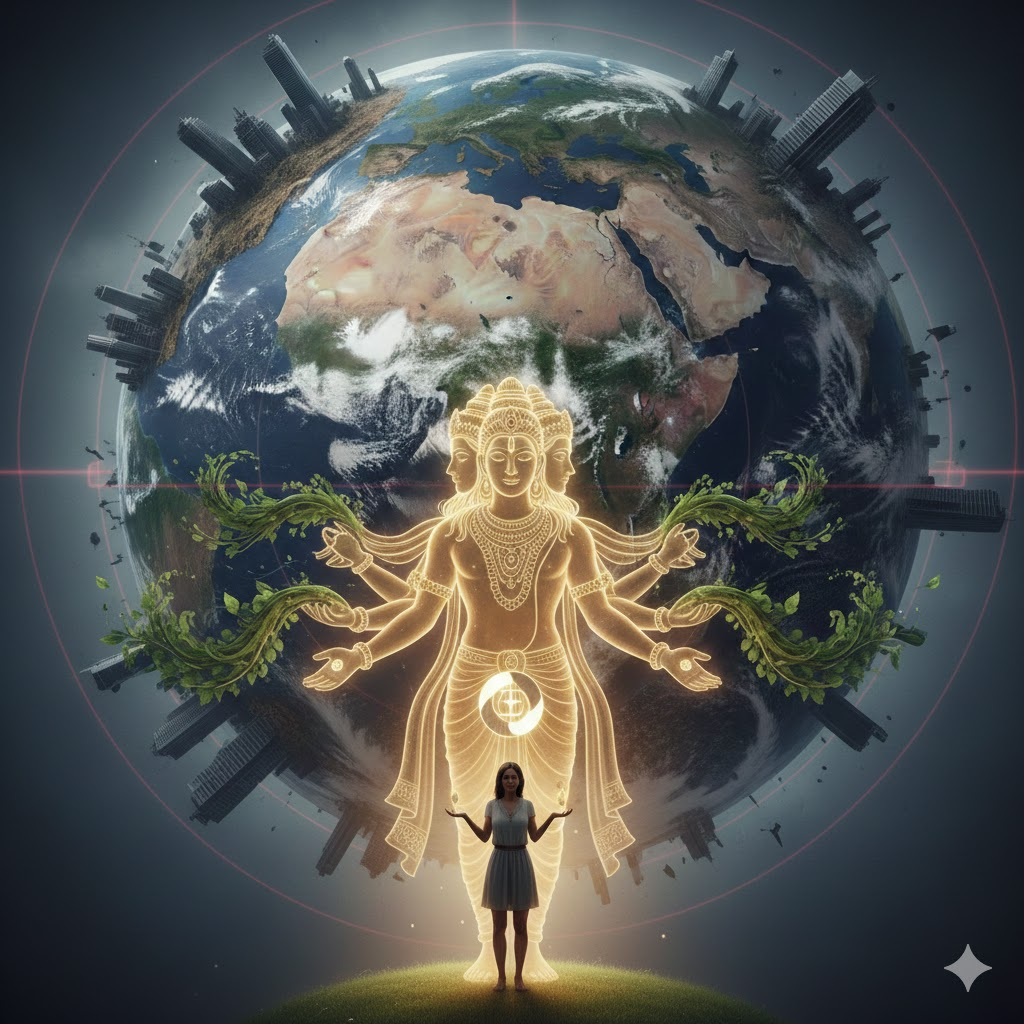
We are hardwired to expand, but we live in a world of finite limits. Discover how aligning with the rhythm of the Vedic Trinity can help us find grounded purpose in an age of environmental and social collapse.
Enjoy this 8-minute read or let me read it to you here.
The Vedic Trinity encompasses the Creator, the Sustainer, and the Destroyer. The drive to self-actualize, tending, and loss are foundational natural laws on cosmic, communal, and personal levels. The interplay between them is important to both comprehend and embody as social, political, and environmental chaos escalates.
At a cosmic level, whether we are considering the movement of stardust, the evolution of life, or the path of a river across the plains, each thing is governed by a set of qualities they are innately compelled to expand. They want to express, unfold, and proliferate as deeply and widely as they can. Black holes want more matter, whales want more plankton, mosses want more territory, baboons want bigger harems, and everything wants to create more little versions of itself.
We humans are simply another creature wanting to self-express and actualize. We want to be seen and heard, to be more beautiful, stronger, and more knowledgeable, to explore and build, to spread our ideas and traditions. Each of us is innately driven to understand and manifest what it means to be ourselves – whether that is in service to the whole or striking out on a rebellious adventure. We long to master, embody, and share what we are as fully as possible.
But this impulse to express, expand, and proliferate cannot continue endlessly. It is inherently destructive because space and energy are finite. So for each thing that expands, something else must recede. The movement of stardust creates gravitational orbits that pressurize atoms into molecules. The bison herd grows and the grass diminishes. The toughest mosses push the weaker to dry out on the sunny side of the boulder. One baboon gets all the mates and the bachelors launch an attack. Nothing can live or actualize without the death or loss of something else.
A look at human history shows how we create at the expense of ecosystems and cultures. One person has a vision to create a temple, so they cut up the mountainside for the stone and enslave the people for labor. One person feels called to spread their beliefs and turns jungle into monoculture and indigenous wisdom into dogma. Each time I eat, an animal or plant gives their life. Each time I speak, someone else must remain silent.
Creation is the intelligence that wants to see what’s possible. It wants to explore, play, express, and experience our essential selves in the world. Destruction is the intelligence that applies limits to what any one thing, species, or natural law can do. It brings fire when there is too much brush, plague when there is over-population, and barren land when we over-farm. Destruction brings revolution when regimes are too greedy or oppressive, broken relationships when we are too self-centered, and exhaustion when we over-exert. Everything dies – species, ecosystems, stars, our dreams, and our bodies – to create space for something else to take its turn.
The third element – that of Sustaining or Maintenance – arises when we understand and live in alignment with this dynamic interplay between Creation and Destruction. Instead of striving or expecting to manifest fully or completely, we respect this natural rhythm, this expression of Cosmic Justice. Anything that survives long enough to Create has attained some level of mastering the art of sustaining its life. Atoms seek others to form stronger bonds, creating the foundation for life. The whale learns to migrate to denser blooms of food, stirring and fertilizing the ocean as it moves. Trees share nutrients and warn each other of impending threats.
We, too, have often mastered sustainability. Humans have lived for tens of thousands of years in Australia and hundreds of thousands in Africa, building cultures that carry knowledge of how much they can take and what they must give back. Healthy organizations find ways to support the gifts and visions of their members, not just harvest the work they produce. And as individuals, we learn how to share time and space with others, balance work and rest, make space for creative expression and playful exploration among our chores and responsibilities.
Each thing must learn how to survive and express within the limitations of its abilities, capacity, and environment. Something always drives us forward, something always holds us back, and from the tension of that opposition we come into being. We are invited to do what I believe is the profound work of having a physical body: nurturing and offering what feels most essential to who and what we are.
This act of becoming, of creating and deepening our essential self, always requires sacrifice. A bison or whale roaming the prairie and sea is always leaving home. A baboon that becomes a mother surrenders her vitality to feeding her young. A cell that joins with others ceases to be self-sufficient and becomes part of a body. I sacrifice time pondering the universe to scrub my shower, show up at the office, and support my friends not because these things are obligations, but because they make me a fuller, deeper human. By respecting the natural law that requires I Sustain in order to ward off Destruction, I give space to Creation. The rawness of living feeds the artist’s muse, the insights of daily life inspire scientific theories, and I better understand my place in the universe when I accept the tasks required of being human in the time and place to which I was born.
Our often tedious daily tasks as well as our losses fuel the inspiration and momentum we need to create – time for a new hobby, space for a new relationship, energy for a big life transition. They also fuel regeneration at the level of community, civilization, and species. In this time of destruction – of wild space, biodiversity, human rights, and life-sustaining beliefs and practices – we are called to create new art, culture, and structure in order to sustain life.
Our rampant creativity and proliferation has pushed past the limits of our planet. If we do not voluntarily release this unbridled consumption, like the ancestors whose wisdom we have eradicated knew they must, Destruction will provide balance. It already is through our collapsing institutions, supply chain, and food systems. If we are to align ourselves with what sustains, we must allow these energies to do their work. We must allow the destruction and decay of what is no longer needed. We must dedicate our energies to creating and preserving the cultural practices that will sustain our lives and whatever life remains when the purging is done.
Now is the time to let nature do its work. Anything we contribute outwardly must serve not what we want to fix, preserve, or build, but what will sustain a way of being that will see us through and seed a new culture aligned with natural law.
Nancy
Discover more from InnerWoven
Subscribe to get the latest posts sent to your email.